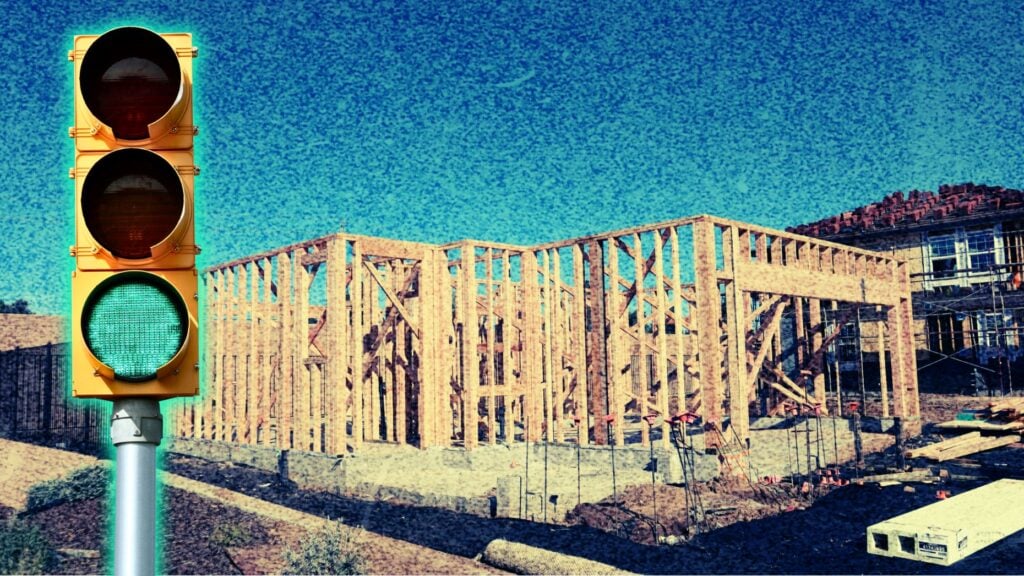

The Department of Housing and Urban Development (HUD) has published a set of recommendations for state and local governments to reduce regulatory barriers to housing construction. However, independent analyses point to mortgage rate lock-in, stretched consumer budgets and tariff-driven volatility as more significant factors driving supply constraints.
The State and Local Best Practices for Home Construction report organizes its guidance into three categories: Cutting home construction costs, unlocking land for new housing supply and accelerating construction timelines.
TAKE THE INMAN INTEL INDEX SURVEY

Scott Turner | Credit: America First Policy Institute
“HUD is encouraging our state and local partners to take inventory of their regulations and policies and make changes that will lower the cost to build and enable more efficient housing supply growth,” HUD Secretary Scott Turner said in a statement.
The White House’s 2026 Economic Report of the President estimates that regulatory costs account for more than $100,000 of the final price of a new single-family home. HUD separately estimated green energy mandates in some jurisdictions add as much as $30,000 to construction costs. A White House fact sheet projects that deregulation efforts undertaken in 2025 will save Americans a collective $212 billion.
The report is part of HUD’s implementation of Executive Order 14394, signed last year, which directs the removal of regulatory barriers to affordable home construction.
What independent data shows
National inventory remains 18.7 percent below historical norms, with new listings down 16 percent versus pre-pandemic levels, according to a Zillow analysis. Active listings were up 3.7 percent year over year in April, and existing-home sales remained 17.7 percent below pre-pandemic levels, Zillow found.
Where inventory has recovered, independent economists point to factors separate from regulatory changes. Inventory has surpassed pre-pandemic levels in 19 of the 50 most populous metros — concentrated in the South and West — where construction activity surged during the pandemic era, according to Zillow.
“Construction boomed across the Sun Belt, and we saw activity slow in many markets as they went through a transition period,” Zillow Senior Economist Orphe Divounguy said. “Those same markets are now coming out the other side as incomes are more in line with prices.”

Orphe Divounguy
The strongest spring recovery in contract signings is concentrated in Midwest markets — Kansas City, Missouri; Louisville, Kentucky; Indianapolis; Columbus, Ohio; and Cincinnati — which Realtor.com Senior Economist Jake Krimmel attributed to “relatively affordable price points, improving inventory, and buyers who are actually showing up,” according to a Realtor.com analysis.
Neither Zillow nor Realtor.com connected supply recovery in those markets to regulatory changes.
Lock-in effect, budgets and tariffs
Both independent analyses identified supply and demand constraints that fall outside the scope of building code or permitting reform.
Homeowners holding pandemic-era mortgage rates between 2.5 and 3 percent remain reluctant to list, a dynamic known as the lock-in effect. “A homeowner with a 2.5 percent or 3 percent interest rate may be reluctant to give that up unless they truly need to move,” Gordon Hageman, a Phoenix-area agent with Arizona 1 Real Estate, told Realtor.com. “That lock-in effect continues to limit the number of new listings entering the market.”
On the demand side, Zillow cited rising consumer costs as a limiting factor: “The rising costs of everything else are one limiting factor, straining budgets and pausing major purchases,” the company said.
Realtor.com’s analysis also named tariff-driven volatility as a headwind that suppressed the spring 2025 market, tariffs on building materials, including lumber and steel, that can increase construction costs, moving in the opposite direction from the savings HUD’s report projects.
What’s next
Contract signings reached their highest level since 2022 in the first four months of 2026, up 2.9 percent year over year, according to Realtor.com. Krimmel said the data suggests a meaningful spike in closings in May and June is possible, though he cautioned the market is “not out of the woods yet,” with geopolitical uncertainty and mortgage rate movement as key variables.


