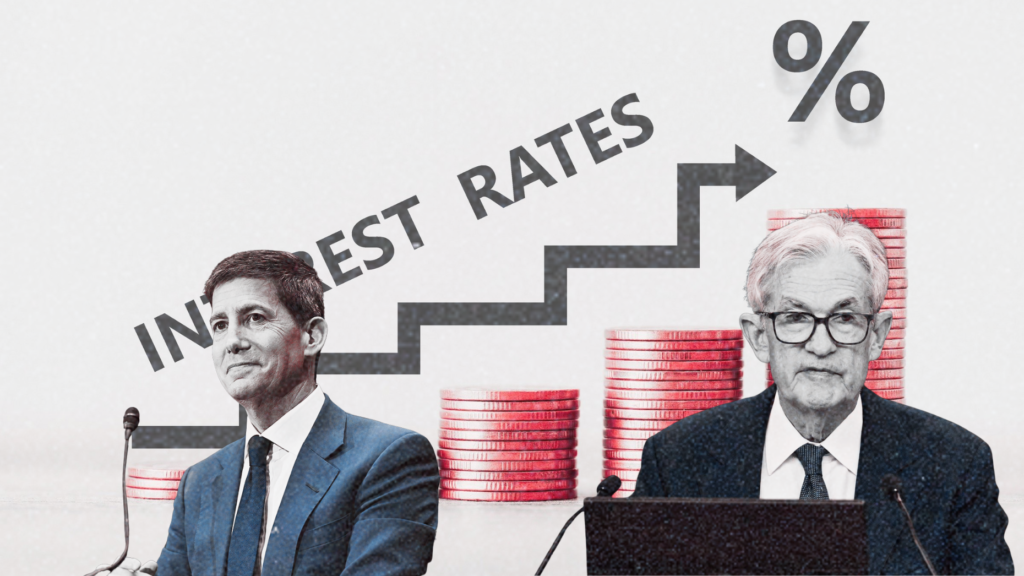

Major central banks left interest rates unchanged last week, but the relative calm came with a warning. Policymakers said they stand ready to raise rates if surging energy prices, tied to the U.S.-Israeli conflict with Iran, feed into broader inflation.
The Federal Reserve voted to hold, but the tone of the decision wasn’t unanimous. Three Fed officials pushed back on the statement’s “easing bias,” arguing the language no longer reflects economic reality. Their dissent suggests the window for rate cuts may be closing faster than markets expect.
TAKE THE INMAN INTEL INDEX SURVEY
The European Central Bank (ECB) and Bank of Japan (BOJ) each held rates but struck a more conditional tone. ECB President Christine Lagarde said the bank is “certainly moving away” from its baseline scenario and acknowledged that a hike was among the options under debate, though the ECB stopped short of signaling that one is imminent.
At BOJ, the hold was more fractious. Three of nine board members dissented in favor of an immediate increase, with Governor Kazuo Ueda warning that if the Iran oil shock produces second-round inflation effects, the bank will raise rates.
For buyers and sellers watching mortgage rates, the signals from abroad matter. A synchronized global shift toward tighter policy tends to put upward pressure on long-term U.S. borrowing costs.
The most divided Fed in decades
The Federal Reserve held rates steady last Wednesday in an 8–4 vote — the most dissents since 1992 — but the four “no” votes pointed in two very different directions.
Three regional bank presidents, Beth Hammack of Cleveland, Neel Kashkari of Minneapolis and Lorie Logan of Dallas, agreed with the hold but opposed the statement’s “easing bias,” the language signaling that cuts are more likely than hikes. Fed Governor Stephen Miran broke the other way entirely, dissenting in favor of an immediate quarter-point cut.
By Friday, all three easing-bias dissenters had gone public with the same warning: The war in Iran has changed the math, and that easing bias language is no longer defensible. Kashkari warned that an extended Hormuz closure could produce a price shock the Fed couldn’t absorb without “potentially a series” of rate hikes.
“With an extended closure of the Strait of Hormuz and potentially further damage to energy and commodity infrastructure in the Middle East … the price shock wave could be much larger than is currently expected,” Kashkari said in a statement.
At his post-meeting press conference, Powell acknowledged that support within the committee for dropping the easing bias in favor of more neutral language — one that treats a hike as equally likely as a cut — has grown.
Powell said he saw no need to rush the change at this meeting, given the uncertainty ahead, but stopped short of ruling it out at the next one. With oil surging from $70 a barrel at the start of the conflict two months ago to $126 this week, and total PCE inflation running at 3.5 percent as of March, the data is moving in the wrong direction.
In a move that drew as much attention as the vote itself, Powell confirmed he will step down as chair when his term ends on May 15, but will remain on the Fed’s board of governors through January 2028. Kevin Warsh, Trump’s nominee to replace him, cleared the Senate Banking Committee the same day.
The path forward is far more certain
Following the Fed’s decision last week to hold the federal funds rate steady, Bankrate Financial Analyst Stephen Kates, CFP, said the path forward for the Fed is far from certain, given high oil prices and simmering underlying inflation in goods and services.
“The labor market concerns appear to have fallen into the background,” Kates said. “The quickly changing circumstances in the global economy mean the Fed will be unable to offer much forward guidance, given the data-dependent nature of this headwind-filled environment.”
Kates added that although Federal Reserve policy has a loose direct relationship with mortgage rates, the policy outlook still carries significant influence over how markets interpret overall economic conditions.
“A cautious Federal Reserve outlook contributes to more conservative lending standards through tighter risk management, higher rates, and wider spreads between the highest and lowest offered rates,” Kates said. “Due to a mix of lender incentives, marketplace complexity, and consumer behavior, borrowers may not find their optimal mortgage rate without investing the time and effort to uncover it through rigorous lender comparisons and improvements to their eligibility.”
The next Fed meeting is in June
Inflation analyst Omair Sharif warned in a note to clients that the Fed could walk into its June meeting facing a May consumer price reading above 4 percent. That would be a level not seen since the post-COVID surge and the fallout from Russia’s 2022 invasion of Ukraine.
That would put Kevin Warsh in a politically fraught position from Day One. The Senate is expected to vote on his confirmation as soon as the week of May 11 — potentially days before Powell’s term expires on May 15 — and Trump has publicly called for rate cuts. But if the inflation data lands where Sharif fears it will, the math may demand the opposite.
For the housing market, the stakes are direct. Powell said at his press conference that support within the committee for dropping the easing bias has grown, and that he saw no need to rush the change at this meeting. The next opportunity is the June 16–17 meeting, Warsh’s first as chair.
If that shift happens, mortgage rates, already elevated, would face renewed upward pressure just as the summer buying season gets underway.


