
A new class of AI is beginning to draw attention among tech geeks and innovators that could impact real estate: autonomous AI “agents” capable of managing complex workflows across multiple software platforms.
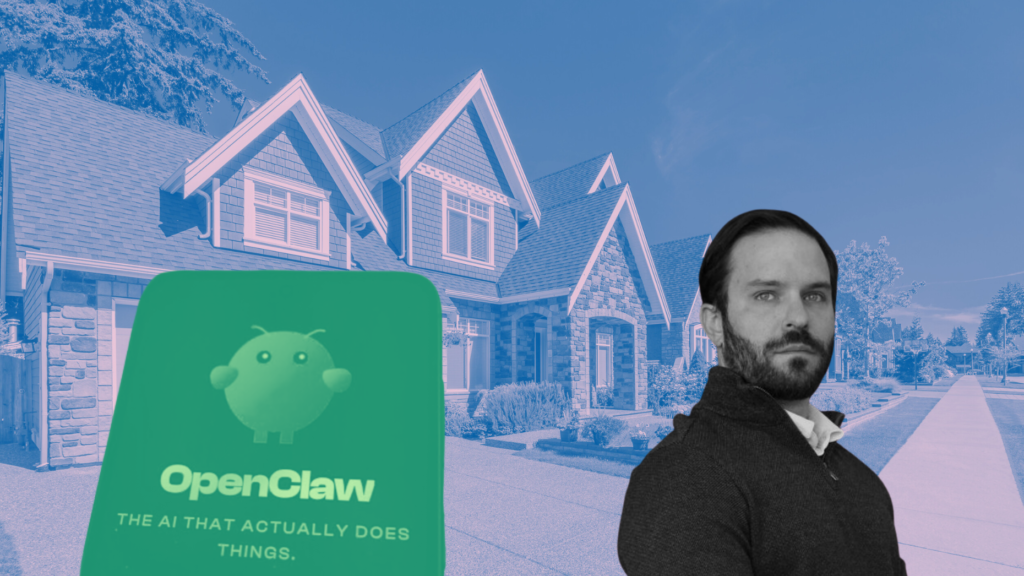
One of the most talked-about systems in developer circles is OpenClaw (formerly Moltbot, Clawdbot, Molty), an open-source platform that allows users to build AI assistants capable of executing tasks across apps, websites and databases.
OpenClaw achieved massive popularity in late January following the Moltbook project, a Reddit-like “social media” site of sorts designed exclusively for AI agents. Last month, the developer behind OpenClaw, Peter Steinberger, announced he would be joining OpenAI.
While the tech remains largely experimental, Canadian real estate broker Daniel Foch says he has spent a month testing OpenClaw specifically for real estate workflows — and believes the industry could benefit significantly from it.
Foch is the Chief Real Estate Officer at Valery.ca and host of Canada’s top-ranked real estate podcast. He is also the co-founder of The Habistat, the data science platform behind TRREB and Proptx, which helps bring greater transparency to the housing market by providing real-time data and analytics to inform decision-making across the industry.
“As far as I know, nobody in the real estate industry has spent more time trying to make OpenClaw work for Realtors than I have,” Foch said in a recent YouTube video documenting his experiments with the platform. “I genuinely believe real estate stands to benefit more than any other industry with a technology like this.”
‘A field job with a desk backend’
Unlike typical AI chatbots that simply generate text or answer questions, OpenClaw is designed to perform tasks autonomously. Or, as their website says, it’s “the AI that actually does things.”
The system can connect to software tools such as email platforms, calendars, databases and CRM systems. Once configured, an AI model can execute instructions across those systems. For real estate agents, whose work often involves juggling multiple software platforms while spending much of their time outside the office, that capability could be particularly useful.
“Real estate is a field job with a desk backend,” Foch said in the video. “Agents are in their cars, at showings, inspections, or listing appointments. They’re not sitting in their CRM or their email all day.” That disconnect between field work and administrative work creates friction in the industry, he said, and AI automation may help reduce it.
AI takes on the boring work
Foch says his customized OpenClaw system now handles a wide range of tasks within his real estate business.
Among other things, he says the AI assistant can update contacts and follow-up tasks inside a CRM, generate listing presentations and home evaluations, schedule showings and add them to his calendar, process paperwork and organize transaction documents, and draft outreach campaigns to potential clients.
The system can also generate content for marketing and media channels, including drafting podcast summaries, newsletter posts and YouTube scripts. In total, Foch estimates the AI assistant now handles roughly 70 percent to 80 percent of the administrative work that previously consumed 20 to 25 hours of his week.
“Before this system, I was spending a huge amount of time context-switching between tasks — formatting documents, updating systems, managing outreach,” he said. Now, he says, AI manages most of those tasks while he and his team supervise the process.
‘Screenless CRM management’
To make OpenClaw useful for agents, Foch says he built integrations with several popular real estate software platforms.
His system can interact with CRM tools commonly used by agents, including Follow Up Boss and kvCORE, using their APIs. He also created automations that allow the AI to manage lead follow-ups, trigger nurture campaigns and update client records.
In one example, he said he can send a text message to his AI assistant instructing it to move a contact to a nurture sequence and schedule a follow-up call. The AI then updates the CRM, triggers the appropriate automations and drafts the follow-up message. For agents who spend much of their time driving between showings or meetings, he says such “screenless CRM management” can be particularly valuable.
Why most agents aren’t using OpenClaw
Despite the potential, OpenClaw remains far from mainstream adoption among real estate professionals.
One reason is complexity. Setting up the system requires technical knowledge, including configuring integrations, building workflows and defining detailed standard operating procedures that guide the AI’s behavior.
Foch says he spent a month documenting the process and creating open-source “skills” that agents can use to replicate his setup. Even then, he says most agents who review the material conclude that building the system themselves would require too much time and technical expertise.
“People keep telling me they just want the benefit,” he said. “They don’t want to go through the whole process of building it.”
In response, Foch and several partners are developing a commercial product that packages OpenClaw-based automation into a ready-to-use system for real estate professionals. The product, called Homie, aims to provide agents with a preconfigured AI assistant integrated with their CRM, phone, and email systems.
The team plans to initially launch the platform with a limited number of users while they refine onboarding and support. While it remains unclear whether systems like OpenClaw will become widely adopted in real estate, Foch believes the technology points toward a larger shift in how agents manage their businesses.
“The industry doesn’t necessarily need instructions,” he said. “It needs packaging.”
An ‘absolute nightmare’ for cybersecurity
There’s another issue, too: cybersecurity.
OpenClaw’s powerful capabilities don’t necessarily mean real estate agents should rush to deploy it. The tech also introduces significant cybersecurity risks, particularly when AI agents are granted access to files, system commands and third-party applications, according to security researchers at Cisco Systems.
“From a capability perspective, OpenClaw is groundbreaking. This is everything personal AI assistant developers have always wanted to achieve. From a security perspective, it’s an absolute nightmare,” Cisco’s Amy Chang and Vineeth Sai Narajala recently wrote.
Because OpenClaw can run shell commands, read and write files, and execute scripts directly on a user’s machine, granting the AI agent high-level permissions could allow it to perform harmful actions if misconfigured or if a user installs a malicious or compromised “skill.”
Researchers have also reported instances where OpenClaw exposed plaintext API keys and credentials. Those credentials could potentially be stolen by attackers through prompt-injection techniques or unsecured endpoints.
Even OpenClaw’s documentation acknowledges the challenge. According to the project’s own guidance, “There is no perfectly secure setup.”
Wired reported last month that Meta and several other tech companies have restricted the use of OpenClaw internally due to security concerns. One Meta executive said he recently instructed his team not to install the software on company laptops, warning that doing so could result in termination.
Speaking on the condition of anonymity to discuss internal policies, the executive said he believes the tool is unpredictable and could potentially create privacy risks if deployed within otherwise secure systems.
That doesn’t mean Meta lacks interest in the technology. The tech giant recently acquired Moltbook, the “social network” for AI agents built on OpenClaw. A Meta spokesperson confirmed that Moltbook will join the company’s Meta Superintelligence Labs. Terms of the deal were not disclosed.
A preview of the AI agent era
For now, OpenClaw remains largely the domain of developers and tech-savvy real estate professionals like Foch. For many agents, the cybersecurity risks outweigh the benefits. Instead, most will likely encounter similar capabilities through packaged software platforms — such as Foch’s Homie or emerging systems like Breezy — rather than building AI agents themselves.
Still, the capabilities Foch demonstrates with OpenClaw offer an early look at what an “agentic” AI future for real estate might look like, with AI handling tedious back-office work while Realtors focus on the IRL side of the business.


