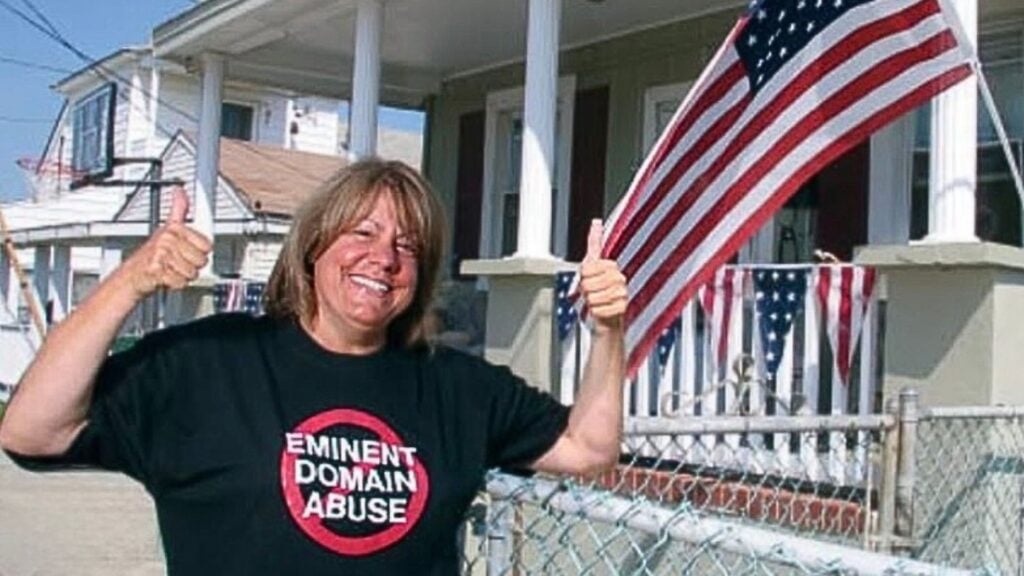

Lori Ann Vendetti is among those women celebrated this Women’s History Month for her dedication to a cause. Fiercely defending her home, she led a band of 36 neighbors on three small blocks in their collective fight against unchecked government overreach in the name of “economic development,” pioneering MTOTSA — an acronym for Marine Terrace, Ocean Terrace and Seaview Avenue — in a 10-year self-preservation fight.
Could this happen to me?
Many homeowners (and many real estate agents) never think about the issue of future eminent domain while they are crafting the perfect offer to win their dream home, but the transaction doesn’t necessarily stop after the sale. Keeping up with future development projects for your clients is not only a great way to stay in touch, but also an even better way to continue building and growing your business in the neighborhoods you are currently selling.
In this article, we will break down a real-world example of eminent domain in action, specifically government overreach, typically in lower-middle-class neighborhoods of older homes with great (water) views. History sets the stage for the future, and it’s up to the residents in a community to be actively involved in how their elected officials play a role in their personal backyard.
The homeowner-turned-activist
Vendetti never intended to be an activist, but she heard an early calling to public service as a police officer for Amtrak and later handled claims of injured employees and passengers.
According to Scott Bullock, president and chief counsel, Institute for Justice, a non-profit public-interest law firm, who guided Lori and defended MTOTSA, “It takes a coalition and a special person who can take the lead as part of a ‘mosaic of people’ who join the fight. Lori Vendetti won the right to lead.”
Bullock summed up Vendetti as principled, doing what’s right, for the right reason, not individual gain, righting a wrong, with a calm temperament and young enough to assemble the older crowd through kindness and being indispensable.
The home by the sea
As a child, Vendetti knew exactly how she would spend summer vacations: At the beach, or as New Jerseyans say, “down the shore.” A city kid growing up in Newark, Vendetti and her family would trade city heat for sea breezes at their summer home at 38 Ocean Terrace, Long Branch, an address and neighborhood that would prove significant years later.
The neighborhood was a patchwork of 37 modest but well-cared-for homes in a tight-knit community where lines blurred between family and friends.
Built by Vendetti’s father in 1960, the home sat on a mere 11th of an acre. What it lacked in land it made up for in location: third house from the ocean, where the beach was their piece of the world, and the view was spectacular.
Vendetti’s truck driver father, who had a 4 a.m. start to his workday to pay for the summer retreat, and her mother were eventually drawn from their home in the city to make Ocean Terrace a year-round residence.
A once-in-a-lifetime opportunity
In 1995, Vendetti had an opportunity to buy the house across the street and felt the “generational pull” of Long Branch, allowing her to be close to her parents in their retirement years.
The owners, friends of the Vendettis, knew it was time to sell when the matriarch-grandmother became too ill to keep the home, but it was a deep blow to lose it.
Vendetti was not the highest bidder, yet the home became hers with the understanding that the family could return every summer to stay in the house so the grandmother’s life would be undisturbed for as long as she lived. Vendetti readily, unselfishly, agreed to the terms.
As the new owner, Vendetti never let on to the grandmother, during the yearly return, that the house was no longer hers. And when questioned, “Lori, does my husband know you’re mowing the lawn?” Vendetti would say with a wry smile, “Yes, Mrs. Rossi, your husband gave me permission.” It was Vendetti’s way to “give back” the home they had given her.
Government self-righteousness: MTOTSA begins its fight
Just months after Vendetti took ownership of her “home across the street,” the City of Long Branch enacted a “redevelopment zone” with a plan to bulldoze the three-block neighborhood for a developer’s luxury condos.
The city hatched a plan to get around the law of eminent domain — the Fifth Amendment to the U.S. Constitution that covers the government’s right to take private property for public use, like a bridge or a highway — by designating the area “blighted,” despite many of the homes being well-maintained.
Side by side, they watched “a tsunami” of homes go down in nearby neighborhoods while a menacing undercurrent arose amid conflicts of interest from politicians and administrators, as developers, buoyed by the bulldozers, seized privately owned oceanfront land to create a veritable “playground for the wealthy.”
Fire department property inspections began, categorizing the homes as OK, Fair or Poor. Not one of the homes was given an OK or a Fair rating. All were deemed “blight.”
The Institute for Justice puts Vendetti on the map
The Institute for Justice taught MTOTSA how to fight through grassroots organizing, including rallies and national press coverage on Fox and other networks.
Having kept MTOTSA on its radar, lead counsel Bullock took MTOTSA’s case all the way to the Supreme Court, resulting in a stunning victory for homeowners.
MTOTSA land is not for sale!
Vendetti’s steely resolve, captured in a YouTube video called “I am Lori Ann Vendetti and This Is My Home,” was no different from other courageous women of history, Crystal Lee Sutton, Erin Brockovich and Susette Kelo, whose “Little Pink House“ changed U.S. law and helped to give MTOTSA its win.
Most of the MTOTSA seniors, post-Supreme Court win, struggled with a new and heavy tax burden. However, since the development was now unforced, it created a legitimate window for investors and homeowners to negotiate a sale price based on fair market value.
NPR’s Anthony Brooks dubbed Vendetti a fighter right from the “get-go,” quoting her in August 2005: “There’s no amount of money that’s going to make us move. And people think everyone has a price. Our group doesn’t have a price.”
The Vendetti story is one of resilience
Today, only Vendetti and three of her neighbors remain in their homes in the neighborhood-beside-the-sea, but the impact of her activism continues. Since she led her community’s fight, 40 states have enacted stricter laws governing eminent domain.
She is proud to say, “People know us now, not just in New Jersey, but across the country. We’ve become a force for freedom. Thank you for helping me fight for it.”
[Author’s note: Lori Ann Vendetti and Inman writer Annette DeCicco share familial roots in Long Branch, New Jersey, discovering during the interview that their great-grandfathers were brothers.]
Annette DeCicco is a real estate broker and director of growth and development at Berkshire Hathaway HomeServices Jordan Baris Realty in Northern New Jersey. Connect with her on LinkedIn and Instagram.


